
Mriga, Mayuri, Shyama, Katha, Madira — What Each Shukra Saree Name Means

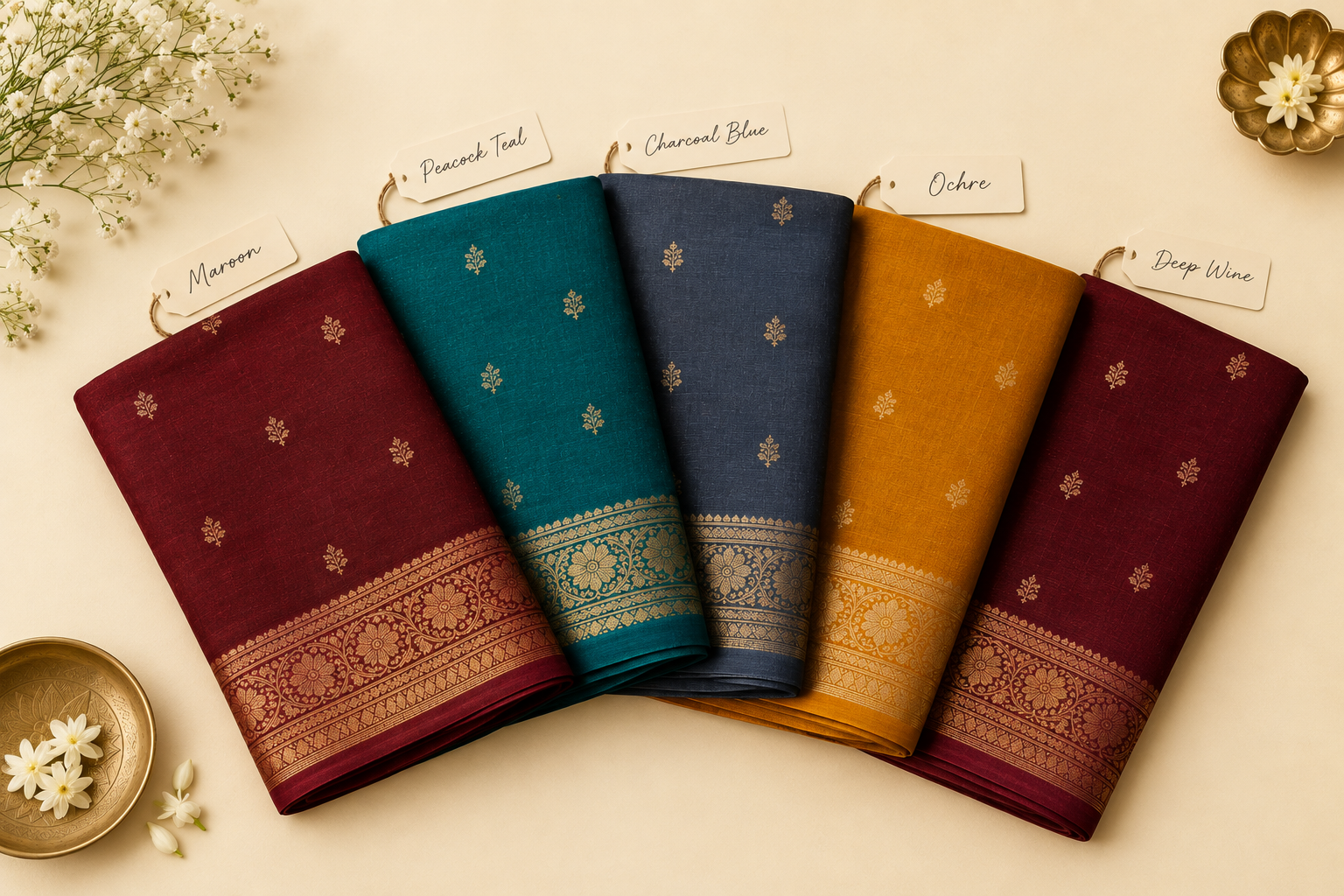
A name, never a number. It’s one of the smaller promises we make, but it changes how a saree feels to own. Here’s what’s actually behind each of the five names in Chapter One, and why we chose words instead of style codes.
Think about how differently it feels to say “I’m wearing my Mayuri tonight” versus “I’m wearing style SK-0472.” One of those sentences has a personality. We wanted every saree in your cupboard to have the former, not the latter.
Mriga
Drawn from the Sanskrit word for deer — the same animal at the centre of our emblem. Quiet, watchful, graceful without ever seeming to try. If our brand had to be summed up in a single saree, Mriga would be a fair place to start.
Mayuri
Associated with the peacock — one of the most celebrated motifs in Indian textile art, from woven borders to hand-painted pallus. Mayuri carries that same sense of considered, unhurried drama: bold, but never loud for the sake of it.
Shyama
A word traditionally used to describe a deep, dusky tone — evening-coloured, a little mysterious. Shyama is for the saree you reach for when you want to feel a shade more enigmatic than usual.
Katha
Simply, “story.” Fitting for a saree built from techniques — block printing, folk motifs — that have been carrying stories across generations long before we came along.
Madira
Evoking something intoxicating, almost heady — the saree equivalent of the effect a genuinely great outfit has on your own confidence.
Why We Never Called Them “Style 1 Through 5”
A number tells you where something sits in a catalogue. A name tells you something about how it might make you feel. That distinction matters more than it sounds — women have spent long enough being sold products described by their features instead of their feelings. We wanted the very first thing you learn about a Shukra saree to be its name, not its SKU.
A Very Old Tradition, Not a New Marketing Idea
Naming a garment isn’t something we invented — it’s something fashion mostly stopped doing. Regional saree weaves across India have carried descriptive, often poetic names for centuries: names tied to a weaving technique, a motif, a place, a story. Somewhere in the shift toward mass production, most of that gave way to product codes and collection numbers. We’re not claiming to have invented anything by naming ours — we’re just refusing to let go of something worth keeping.
How the Five Work Together
None of the five names were chosen in isolation — together, they were meant to span a genuine emotional range, so that “which Shukra saree are you” has five honestly different answers rather than five slight variations on the same mood. Mriga for quiet grace, Mayuri for considered drama, Shyama for a touch of mystery, Katha for meaning and story, Madira for pure, heady confidence. Most women recognise themselves in more than one.
Frequently Asked Questions
How do I decide which saree name — and saree — is right for me?
Less about matching a strict definition, more about which description pulled at you while reading. That instinct is usually the right one.
Will future Shukra pieces also carry Sanskrit-inspired names?
The naming philosophy — a name, never a number — is core to how we design, so yes, expect it to continue as new chapters arrive.
Are these translations exact, or more like a feeling the word evokes?
More the latter — Sanskrit words often carry layered, poetic meanings that don’t translate into a single English word cleanly. We chose the association that felt truest to each saree, rather than a strict dictionary definition.
Meet all five in person → Shop the collection
We’d Love to Hear From You
Chapter Two is already taking shape, and we’re building it with people who read all the way to the end of a blog post — which, if you’re here, is you.
Subscribe below and you’ll hear about new sarees, new stories, and new chapters before anyone else does. And if you have a thought, a question, or something you’d like us to write about next, don’t keep it to yourself — we read every message.