
The Thousand-Year Thread: A Short History of India’s Textile Craft

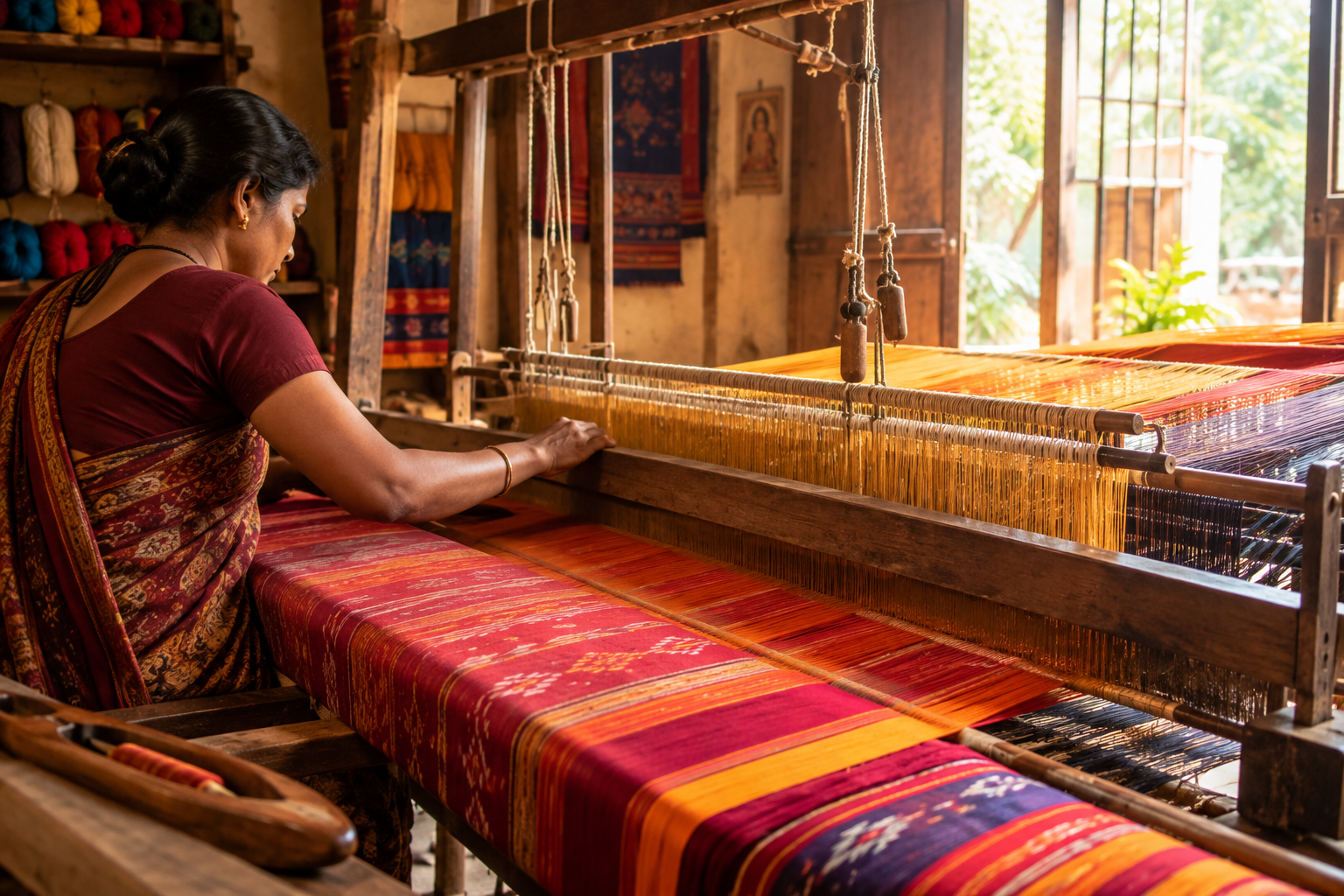
India’s relationship with textiles goes back thousands of years — long before “fashion” was a word anyone used, weaving and dyeing were already sophisticated, regionally distinct art forms passed down through generations of families.
Where the Saree Begins
The saree itself is one of the oldest known garments still in everyday use anywhere in the world, with roots historians trace back several thousand years. Its basic form — a single unstitched length of fabric, wrapped and draped rather than cut and sewn — has remained remarkably consistent even as the fabrics, techniques, and styles around it evolved dramatically by region.
There’s something worth sitting with in that fact: the exact silhouette a woman drapes around herself today is, in its essential shape, recognisable across thousands of years of the women who wore it before her. Very few garments in human history can claim that kind of continuity.
A Country of a Thousand Weaves
Nearly every region of India developed its own textile identity: the silk weaving traditions of Varanasi and Kanchipuram, the hand block printing of Rajasthan, the intricate resist-dyeing techniques of Gujarat, and countless folk art traditions passed down through specific communities. No single “Indian textile” exists — it’s a patchwork of hundreds of distinct regional crafts, each with its own history.
What’s easy to miss from the outside is how localized this knowledge actually is — a specific block-carving technique might belong almost entirely to one town, refined within a handful of families over generations, never fully replicated anywhere else. Buying into that craft isn’t just buying fabric. It’s buying a small, specific piece of a much larger, much older story.
How Old Traditions Ended Up in a Shukra Box
When we talk about being “rooted in India’s textile heritage,” this is what we mean specifically — silks, block prints, and folk art techniques refined over generations, reworked into a modern, easier-to-wear format without losing what made them worth preserving in the first place.
Why This History Is Worth Knowing, Not Just Owning
It changes how a saree feels to wear, honestly. Knowing that the block print on your saree traces back to a specific regional technique, refined over centuries by artisans whose names we may never know, adds a kind of weight that has nothing to do with price. You’re not just wearing fabric. You’re wearing a small, living piece of a very long story.
How These Crafts Have Survived This Long
It’s worth being honest about the fact that many of these traditions have survived not because of grand institutional protection, but because individual families kept teaching them to the next generation even through periods when demand nearly disappeared. Machine-made alternatives are cheaper and faster, and for decades that put real pressure on hand-craft communities. Every purchase of a genuinely handcrafted piece is a small vote for that skill continuing to be worth passing down.
What Gets Lost If Nobody Buys Handcrafted Anymore
It’s not abstract — a specific block-carving technique that exists in only a handful of workshops can disappear within a single generation if there’s no economic reason for a young person to spend years learning it instead of taking an easier, faster-paying job elsewhere. History like this isn’t preserved in a museum. It’s preserved in continued use, which is a slightly uncomfortable but important thing for any of us buying textiles to sit with.
How to Spot the Difference in Your Own Hands
Genuine hand block print, for instance, carries small, honest irregularities — a motif that’s very slightly offset from the one beside it, a line that isn’t perfectly uniform in thickness. Machine printing is flawless in a way hand craft never quite is. Once you know to look for it, that imperfection stops reading as a flaw and starts reading as proof — a fingerprint left by an actual person, on an actual day, at an actual loom or printing table.
Frequently Asked Questions
Which specific weaving or printing traditions does Shukra draw from?
[Confirm the exact regions, techniques, and artisan partnerships to name specifically before publishing, so the post reflects your actual sourcing.]
See the heritage in every piece → Shop the collection
We’d Love to Hear From You
Chapter Two is already taking shape, and we’re building it with people who read all the way to the end of a blog post — which, if you’re here, is you.
Subscribe below and you’ll hear about new sarees, new stories, and new chapters before anyone else does. And if you have a thought, a question, or something you’d like us to write about next, don’t keep it to yourself — we read every message.