
How to Drape a Saree in Under 10 Minutes, No Pins Required

How to Drape a Saree in Under 10 Minutes, No Pins Required
“How to drape a saree” is one of the most-searched saree questions there is — and for good reason. It looks complicated from the outside. It isn’t, once you break it into steps and remove the parts that used to slow everyone down.
If you’ve ever watched someone drape a saree in what looks like ninety seconds flat and wondered what you’re missing, the honest answer is: repetition, and a saree that’s already finished. Nobody is born knowing how to fold six yards of fabric into clean pleats. It’s a small, learnable skill — and most of the difficulty people associate with it is actually friction from an unfinished saree, not the draping itself.
Before You Start: What You’ll Need
A saree with the fall already stitched (so the bottom edge holds its shape), a well-fitted blouse and petticoat underneath, and a couple of safety pins for the pallu, even in a “no-pins-required” routine — think of them as backup, not a requirement for the main drape [general guidance — verify against Shukra’s specific product instructions before publishing].
Give yourself a full-length mirror and a little bit of room to turn around in. Draping in a cramped space is where most of the fumbling actually happens — it’s rarely the fabric’s fault.
The Steps
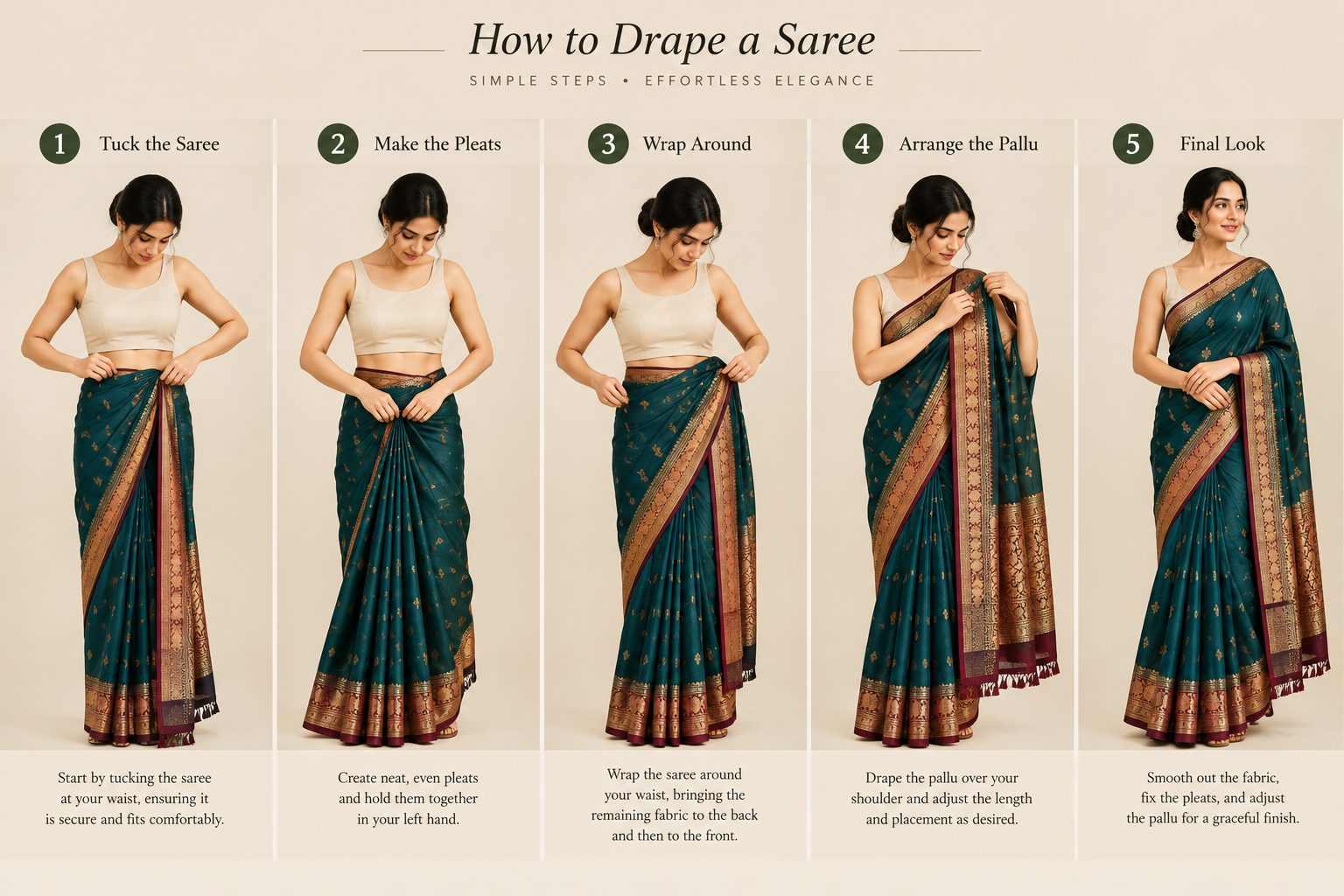
1. Tuck the plain end of the saree into the petticoat at your waist, starting at the right side and wrapping it once around your body.
2. Make 5–7 even pleats with the remaining fabric in front, and tuck them into the petticoat at the centre, just left of your navel.
3. Wrap the rest of the fabric around your body once more from left to right.
4. Drape the pallu — the decorative end — over your left shoulder, letting it fall naturally down your back or arranging a few loose pleats for a fuller look.
5. Adjust everything at the waist and shoulder until it sits comfortably and secure the pallu with a single pin at the shoulder if you’d like it to hold through a long day.
Common Draping Mistakes (and How to Avoid Them)
The most common issue is pleats of uneven width, which throws off the whole front fall — take an extra thirty seconds to even them out before tucking. The second is tucking too loosely, which is why a well-fitted petticoat matters more than people expect. Get those two right and the rest genuinely does take under ten minutes.
A third, less obvious mistake: rushing the first wrap around the waist. If that base layer sits crooked, everything built on top of it — the pleats, the pallu — inherits the same tilt. Thirty extra seconds at step one saves several minutes of re-adjusting later.
How Practice Changes the Timeline
The first time, give yourself fifteen to twenty minutes and don’t rush it — that’s completely normal. By the third or fourth time, most people are down to eight to ten minutes without trying to be fast. By the tenth saree, it stops requiring conscious thought at all, the same way tying shoelaces did once. The goal on day one isn’t speed. It’s just getting the pleats even.
One Style to Master Before You Branch Out
There are dozens of regional draping styles across India, and it’s tempting to try to learn several at once from watching videos online. Don’t. Master the basic Nivi-style drape covered above until it’s genuinely automatic, and only then start experimenting with variations like the Bengali or Gujarati style pallu. Trying to learn three styles simultaneously is the single most common reason beginners give up on draping altogether.
A Quick Fix If Something Slips Mid-Event
If the pallu starts slipping off your shoulder during a long event, don’t try to re-drape the whole saree — just re-pin it at the shoulder with a slightly firmer angle, catching a bit more fabric than before. If the waist tuck feels loose, a discreet hand-tighten of the petticoat drawstring underneath (in a washroom, not in public) fixes it faster than redoing the pleats. Almost every mid-event saree emergency has a thirty-second fix that doesn’t require starting over.
Frequently Asked Questions
Do I need pins at all?
Not strictly — a well-tucked petticoat and evenly folded pleats can hold on their own. Most people still use one pin at the shoulder for extra security through a long day.
How long should draping actually take once I know the steps?
With practice, most people get comfortable draping a saree in five to ten minutes.
Can I re-drape the same saree in a different style later?
Yes — the same saree can be draped in several traditional styles depending on the region and occasion, without any change to the garment itself.
What if my pleats keep coming undone while I tuck them?
This is almost always a petticoat fit issue rather than a technique issue — a petticoat that’s too loose won’t hold pleats securely no matter how neatly they’re folded. Tightening the petticoat waistband first solves this more often than re-doing the pleats.
Try it with a saree built to make this even easier → Shop the collection
We’d Love to Hear From You
Chapter Two is already taking shape, and we’re building it with people who read all the way to the end of a blog post — which, if you’re here, is you.
Subscribe below and you’ll hear about new sarees, new stories, and new chapters before anyone else does. And if you have a thought, a question, or something you’d like us to write about next, don’t keep it to yourself — we read every message.